Indigenous Peoples Quiz: Which Country Is Their Home?
Indigenous peoples live on every inhabited continent, with their own languages, knowledge and ways of life. Read about 77 peoples, each with a photo from their culture, then guess the country where each one mainly lives today. Many peoples live across borders; the quiz never offers those other countries as wrong answers.
Meet the peoples in this quiz
Africa

Maasai beadwork. Photo: Cecilia Nkini, CC BY-SA 4.0, via Wikimedia Commons  Maasai
Kenya · also TanzaniaThe Maasai are a pastoral people of the Great Rift Valley in southern Kenya and northern Tanzania. They speak Maa, a Nilo-Saharan language. Cattle herding has long been at the centre of Maasai life, and age-sets, groups of people initiated together, shape community roles throughout life.
In Maasai age-sets, men initiated together move through life stages as a group, roughly every 15 years, until they become senior elders.

A Hadza man starting a fire. Photo: BrixL, CC BY-SA 4.0, via Wikimedia Commons  Hadza (also known as Hadzabe)
TanzaniaThe Hadza are an Indigenous people who live in the hills and valleys around Lake Eyasi in northern Tanzania, numbering about 1,300 to 1,500. They speak Hadzane, a language isolate unrelated to any other known language. Hunting and gathering remain central to Hadza life today.
In 2011 Tanzania issued communal land titles to Hadza communities, recognising their rights to their land.

Rock paintings in the Tsodilo Hills. Photo: Joachim Huber, CC BY-SA 2.0, via Wikimedia Commons  San
San
Botswana · also Namibia, Angola, South Africa, Zambia, ZimbabweThe San are Indigenous peoples of southern Africa, living mainly in Botswana, Namibia and southeastern Angola, with the largest number in Botswana's western Kalahari. They include many distinct communities, such as the !Kung and the |Gui. San communities are known for their deep knowledge of hunting and gathering in the Kalahari.
San bands of 25 to 60 people have traditionally governed themselves without formal chiefs, with influence earned through skill and experience.
Sources

Amazigh silver jewellery. Photo: Mariam.J, CC BY-SA 4.0, via Wikimedia Commons  Amazigh (also known as Imazighen, Berber)
Morocco · also Algeria, Tunisia, Libya, Egypt, Mali, Niger, Mauritania, Burkina FasoThe Amazigh (plural Imazighen) are the Indigenous peoples of North Africa, whose presence there long predates the arrival of Arabic. They live in Morocco, Algeria, Tunisia, Libya, Egypt, Mali, Niger and Mauritania, and include the Kel Tamasheq of the Sahara. They speak Amazigh (Tamazight) languages of the Afro-Asiatic family.
Morocco's 2011 Constitution made Tamazight an official language alongside Arabic, and Algeria did the same in 2016.

The Agadez cross, a silver pendant made by Tuareg jewellers. Photo: Amadouibrahim2, CC BY-SA 4.0, via Wikimedia Commons  Kel Tamasheq (also known as Tuareg)
Niger · also Mali, Algeria, Libya, Burkina FasoThe Kel Tamasheq, "the people who speak Tamasheq", live across the Sahara and Sahel, with the largest number, around one million, in Niger. They speak Tamasheq, an Amazigh language. Herding camels and cattle and long-distance caravan trade have been central to their way of life.
The Kel Tamasheq have preserved their own script, Tifinagh, which is related to writing used in ancient Libya.

Toubou (Teda) men with their camels at a ceremony. Photo: Vincent van Zeijst, CC BY-SA 4.0, via Wikimedia Commons  Teda (also known as Tubu, Toubou)
Chad · also Niger, LibyaThe Teda live in the eastern and central Sahara, around the Tibesti Mountains of northern Chad and into Niger and Libya. They speak Tedaga, a Saharan language related to Kanuri. Some Teda are nomadic herders of camels, goats and cattle, while others farm dates and grains at oases.
The Tibesti Mountains, homeland of the Teda and Daza, rise from the Sahara mostly in northwestern Chad.

A traditional Ogiek family hut at the Nairobi National Museum. Photo: Dolon Prova, CC BY-SA 4.0, via Wikimedia Commons Ogiek
KenyaThe Ogiek are an Indigenous people of Kenya who live in and near the highland forests of central Kenya, especially the Mau Forest. Historically forest hunter-gatherers, they still depend on the forest, and many now also farm and keep livestock. Beekeeping and honey are central to Ogiek life and culture.
Ogiek honey from the Mau Forest is protected as a Slow Food Presidium, honouring Ogiek beekeeping traditions.

A Himba village near Opuwo. Photo: Hans Hillewaert, CC BY-SA 4.0, via Wikimedia Commons  Himba
Himba
Namibia · also AngolaThe Himba are a semi-nomadic pastoral people of the Kunene region of northwestern Namibia and southwestern Angola. They speak a form of Herero (Otjiherero). Cattle herding is at the heart of Himba life, and they have kept many of their traditional social and cultural practices.
The Himba's ancestors settled along the Kunene River in the 16th and 17th centuries, and their homeland still follows the river today.
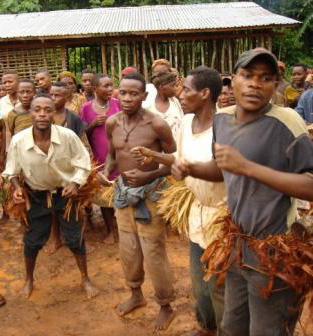
Baka dancers in eastern Cameroon. Photo: Embassy of the United States of America to Cameroon, Public domain, via Wikimedia Commons  Baka
Baka
Cameroon · also Gabon, Republic of the CongoThe Baka are an Indigenous people of the rainforests of southern Cameroon, Gabon and the Republic of the Congo. The forest provides food, medicine and the basis of their spiritual life, and they are semi-nomadic hunters and gatherers. Their sustainable hunting respects the breeding seasons of forest animals.
Baka knowledge of the forest is so detailed that their language has over 28 words to describe elephants.

A museum scene of Mbuti men on a hunt in the Ituri forest. Photo: Vicpeters, CC BY 4.0, via Wikimedia Commons  Mbuti (also known as Bambuti)
Democratic Republic of the CongoThe Mbuti are an Indigenous people of the Ituri Forest in the Democratic Republic of the Congo. They live in small, mobile bands, hunting with nets, spears and bows and gathering in the forest, and trade forest products with neighbouring farmers. Mbuti communities have no formal chiefs and settle disagreements through discussion.
Music and dance are central to Mbuti life, accompanying their celebrations and expressions of belief.

A camel caravan carrying salt across the Danakil desert. Photo: A.Savin, FAL, via Wikimedia Commons  Afar
Afar
Ethiopia · also Djibouti, EritreaThe Afar live in the hot lowlands of northeastern Ethiopia, southeastern Eritrea and Djibouti. They speak Afar ('Afar Af), an Eastern Cushitic language. Most Afar families herd goats, camels and cattle, while others fish on the coast or farm.
Alongside herding and fishing, Afar communities mine and trade salt from the desert lowlands of the Horn of Africa.
Americas

An inuksuk, a stone landmark built by Inuit (this one stands in Quebec City). Photo: User:Guillom, CC BY-SA 3.0, via Wikimedia Commons  Inuit
Inuit
Canada · also Denmark, United States, RussiaIn Canada, most Inuit live in Inuit Nunangat, an Arctic homeland of four regions, and Inuit also live in Greenland, Alaska and Russia's Chukotka. Many speak Inuktut, written in both syllabics and roman letters, and Inuktitut is an official language of Nunavut. Sharing country food such as seal, caribou and narwhal, cooperation and respect for elders remain central to community life.
Inuit Nunangat, the Inuit homeland in Canada, covers about 40 per cent of the country's land area and 72 per cent of its coastline.

A ceinture fléchée (arrow sash), a woven sash worn by Métis people. Photo: Themightyquill, CC BY 3.0, via Wikimedia Commons Métis
Canada · also United StatesThe Métis are one of Canada's three recognized Indigenous peoples, a nation that grew largely out of Western Canada and the Red River Settlement. Their language, Michif, combines Cree or Saulteaux verbs with French nouns and is taught in many Métis communities today. More than 620,000 people identified as Métis in Canada's 2021 Census.
Métis floral beadwork, which blends Indigenous beading with European flower designs, earned the Métis the nickname 'the Flower Beadwork People'.

Plains Cree moccasins with beadwork, about 1890 (Bata Shoe Museum). Photo: Daderot, CC0, via Wikimedia Commons Cree (also known as nēhiyawak, ininiw)
Canada · also United StatesThe Cree are the most populous and widely distributed Indigenous people in Canada, with Plains, Woods, Swampy and James Bay (Eastern) Cree communities stretching from Alberta to Quebec. Cree is an Algonquian language with many related dialects, and more than 86,000 people spoke it in 2021. Hunting moose and caribou, and travel by canoe in summer and by snowshoe and toboggan in winter, long shaped Cree life, and many Cree still value hunting today.
Cree women are renowned for their beadwork, and the walking out ceremony joyfully welcomes young children into the community.

A round Mi'kmaq box decorated with porcupine quills. Photo: Thomas Quine, CC BY 2.0, via Wikimedia Commons Mi'kmaq (also known as L'nu)
Canada · also United StatesThe Mi'kmaq live in Mi'kma'ki, a homeland of seven districts covering Canada's Maritime provinces and the Gaspé coast, with most communities today in Nova Scotia and New Brunswick. Their language belongs to the Eastern Algonquian family, and in 2022 Nova Scotia recognized Mi'kmaw as the province's first language. Life traditionally moved with the seasons between the coast and inland, harvesting shellfish, fish and game.
Mi'kmaw artists are known for ornate porcupine quillwork on clothing and chair seats, a tradition contemporary artists continue to reinterpret.

A Haida totem pole from Tanu, Haida Gwaii. Photo: Vysotsky, CC BY-SA 4.0, via Wikimedia Commons Haida
Canada · also United StatesThe Haida Nation's homeland is Haida Gwaii, the islands off British Columbia's north coast, and Kaigani Haida live on Prince of Wales Island in Alaska. The Council of the Haida Nation looks after the lands and waters of Haida territory and works to carry forward Haida culture and language. Fishing, especially for salmon and halibut, has long supported a rich artistic and ceremonial life.
Haida carvers create tall painted poles displaying family crests, and the Haida Heritage Centre at Kay Llnagaay showcases Haida art and architecture.

Innu building canoes near Sheshatshiu, Labrador, about 1920. Photo: Fred C. Sears, Library and Archives Canada (PA-148593), Public domain, via Wikimedia Commons Innu
CanadaThe Innu live in Nitassinan, a vast boreal homeland spanning eastern Quebec and Labrador, in communities such as Sheshatshiu, Natuashish, Uashat mak Mani-utenam and Mashteuiatsh. They speak Innu-aimun, an Algonquian language written in syllabics or Latin script. Caribou has long been the most revered animal, and hunters traditionally used nearly every part of it.
'Innu' means 'people' in Innu-aimun, and the Innu Nikamu music festival has celebrated Innu music every summer since 1985.

A Kwakwaka'wakw transformation mask. Photo: Myrabella, CC BY-SA 4.0, via Wikimedia Commons Kwakwaka'wakw (also known as Kwakiutl)
CanadaThe Kwakwaka'wakw live along the waterways between Vancouver Island and the British Columbia mainland. Their language is Kwak'wala, which the U'mista Cultural Society in Alert Bay helps revitalize through language programs. Carving, dance regalia, canoes and the potlatch are at the heart of Kwakwaka'wakw cultural life.
The name Kwakwaka'wakw means 'those who speak Kwak'wala', so the nation is defined by its shared language.

Wampum belts held by Six Nations fire keepers, photographed in 1872. Photo: Jas. N. Edy, Library and Archives Canada (PA-124105), Public domain, via Wikimedia Commons Haudenosaunee (also known as Iroquois, Six Nations)
Canada · also United StatesThe Haudenosaunee, the 'People of the Longhouse', are a confederacy founded by the Mohawk, Oneida, Onondaga, Cayuga and Seneca nations, later joined by the Tuscarora. Their communities are in southern Ontario and Quebec and in New York State. Each nation has its own council, with chiefs chosen by the Clan Mothers, and a Grand Council handles matters affecting all the nations.
The Onondaga Nation are the 'Keepers of the Fire', and the Haudenosaunee Grand Council meets on Onondaga territory in New York State.

A Navajo (Diné) hogan, a traditional home, on the Navajo Nation. Photo: Kaldari, CC0, via Wikimedia Commons  Diné (also known as Navajo)
United StatesThe Diné live in the American Southwest, where the Navajo Nation governs its lands through local chapters and its own executive, legislative and judicial branches. They speak Diné bizaad, an Apachean language of the Athabaskan family. Nearly 425,000 people claimed at least partial Navajo descent in the 2020 US census, making the Diné one of the largest Native nations in the United States.
Diné bizaad belongs to the Athabaskan family, related to languages spoken by Dene peoples far to the north in Canada and Alaska.

A painted Lakota canvas tipi from about 1900. Photo: Tim Evanson from Cleveland Heights, Ohio, USA, CC BY-SA 2.0, via Wikimedia Commons Lakota (also known as Teton Sioux)
United StatesThe Lakota are the western division of the Oceti Sakowin, the alliance often called the Sioux, and are made up of seven divisions. Lakota, Dakota and Nakota are dialects of one language. Communities such as the Standing Rock Sioux Tribe, home to Lakota and Dakota people on the North Dakota–South Dakota border, work to protect their language and culture.
Powwows, opening with a colourful Grand Entry of dancers, are highlights of community life on Lakota reservations such as Cheyenne River.

A Cherokee basket by Charlotte Coats. Photo: Charlotte Coats from Garden Grove, USA, CC BY 2.0, via Wikimedia Commons Cherokee
United StatesThe Cherokee are one of the largest Native nations in the United States. Cherokee Nation, the largest of three federally recognized Cherokee governments, is based in Tahlequah, Oklahoma, and serves a 14-county reservation area. The Nation works to preserve Cherokee language, culture and values for future generations.
In 1821 Sequoyah completed a syllabary of 86 symbols for Cherokee, and in 1828 the Cherokee Phoenix became the first Native American newspaper.

A Hopi katsina figure on display in a museum. Photo: Ethan Doyle White, CC BY-SA 4.0, via Wikimedia Commons Hopi
United StatesThe Hopi Tribe is a sovereign nation in northeastern Arizona, with a reservation of more than 1.5 million acres and 12 villages on three mesas. The Hopi are the westernmost of the Pueblo peoples and speak Hopi, a Northern Uto-Aztecan language. Farming, especially of corn, has long been central to Hopi life, and the Hopi have kept their culture, language and religion strong.
Hopi belongs to the Uto-Aztecan language family, making it a distant relative of Nahuatl, spoken by the Nahua of Mexico.

Hula kahiko, traditional Hawaiian dance, in Hawaiʻi Volcanoes National Park. Photo: Ron Ardis, CC BY-SA 2.0, via Wikimedia Commons Kānaka Maoli (also known as Native Hawaiians)
United StatesKānaka Maoli are the Indigenous people of the Hawaiian Islands, whose ancestors voyaged there from other Polynesian islands. ʻŌlelo Hawaiʻi, a Polynesian language, is one of Hawaii's two official languages and has been revived through Hawaiian-language immersion schools. Hula, danced to chant and traditional instruments such as gourds and drums, remains a vital expression of Hawaiian culture.
The Polynesian Voyaging Society, founded in 1973, sails the canoe Hōkūleʻa to keep the art and science of traditional Polynesian voyaging alive.

A Yup'ik bird mask from about 1900. Photo: Daderot, CC0, via Wikimedia Commons Yup'ik
United States · also RussiaThe Yup'ik live mainly in southwestern Alaska, in dozens of villages along the Yukon and Kuskokwim rivers and the Bering Sea coast that are reached by boat, plane or snowmachine rather than by road. Their language, Yugtun, has been ranked the second most common Native language spoken in the United States. Subsistence hunting, fishing and gathering remain central to Yup'ik life.
The Yup'ik Atlas records more than 3,000 traditional place names across the Yukon-Kuskokwim region.

A Tlingit blanket in the Sheldon Jackson Museum, Sitka. Photo: Joe Mabel, CC BY-SA 4.0, via Wikimedia Commons Tlingit (also known as Lingít)
United States · also CanadaThe Tlingit live on the islands and coast of Southeast Alaska, where salmon fishing has long been central to life. Tlingit society is organized into two moieties and many clans traced through the mother's line. Organizations such as Sealaska Heritage Institute in Juneau work to perpetuate Tlingit language, art and culture.
Every two years, Celebration brings Tlingit, Haida and Tsimshian people together in Juneau for Alaska's second-largest Native gathering.

Women with market baskets in Cuetzalan, Puebla. Photo: Santi LLobet, CC BY 2.0, via Wikimedia Commons  Nahua
Nahua
Mexico · also El SalvadorThe Nahua live in many communities across central Mexico. They speak Nahuatl, the language of the Aztecs, in several regional varieties. Many are farmers growing maize, beans, chili peppers, tomatoes and squash, and weaving cotton and wool is an important craft.
Nahuatl is Mexico's most widely spoken Indigenous language, used by more than a fifth of the country's Indigenous-language speakers.

A woman in a white embroidered huipil in Valladolid, Yucatán. Photo: Adam Jones, CC BY-SA 2.0, via Wikimedia Commons Yucatec Maya
Mexico · also BelizeThe Maya of the Yucatán Peninsula live in the Mexican states of Yucatán, Campeche and Quintana Roo, where Maya is the predominant Indigenous language. They are part of the wider Maya world that stretches across southern Mexico, Guatemala and northern Belize. In Yucatán state nearly a quarter of people speak an Indigenous language.
Maya is Mexico's second most widely spoken Indigenous language, spoken by roughly one in ten of the country's Indigenous-language speakers.

Zapotec rugs woven by Isaac Vásquez García in Teotitlán del Valle. Photo: Friends of Oaxacan Folk Art, CC BY-SA 3.0, via Wikimedia Commons Zapotec
MexicoThe Zapotec live mainly in the state of Oaxaca in southern Mexico, in village communities where land is generally held in common. Zapotec is a group of Oto-Manguean varieties that differ so much from town to town that many are considered separate languages. Communal work and mutual aid between relatives, friends and neighbours support farming, festivals and public projects.
Zapotec weavers in towns such as Yalálag, Zoogocho and Talea make backstrap-loom textiles of wool, silk and cotton.

Rarámuri women in traditional dress in the Sierra Tarahumara. Photo: Oscar1, CC BY-SA 4.0, via Wikimedia Commons Rarámuri (also known as Tarahumara)
MexicoThe Rarámuri live mostly in the Sierra Tarahumara of Chihuahua, a land of high peaks and deep canyons such as the Copper Canyon, with smaller communities in Durango, Sonora and Sinaloa. Their Uto-Aztecan language has several regional variants. Families live in dispersed rancherías, growing maize and raising goats and cattle.
Rarámuri are famed long-distance runners; in the traditional carrera de bola, runners kick a wooden ball over great distances.

A Wixárika (Huichol) yarn painting of the sun. Photo: Jebulon, CC0, via Wikimedia Commons Wixárika (also known as Huichol)
MexicoThe Wixárika live in the mountains of the Sierra Madre Occidental, mainly in the states of Jalisco and Nayarit in western Mexico. Their language, also called Wixárika, is a Uto-Aztecan language closely related to Cora. Families live in dispersed rancherías and farm maize, beans and squash on steep hillside plots.
Wixárika artists are celebrated for vivid yarn paintings and for beadwork made by pressing tiny beads into a beeswax-coated form.

Fishermen with butterfly nets on Lake Pátzcuaro near Janitzio. Photo: Thelmadatter, CC BY-SA 3.0, via Wikimedia Commons P'urhépecha (also known as Purépecha)
MexicoThe P'urhépecha live in about 165 communities in the state of Michoacán in western Mexico. Their music, pirekua, is passed down orally and its songs tell of history, religion, social thought and love. Sung by both men and women, solo or with choirs and orchestras, pirekua is a marker of identity and a way of dialogue within families and communities.
Pirekua, the traditional song of the P'urhépecha, was inscribed on UNESCO's list of the Intangible Cultural Heritage of Humanity in 2010.

Members of a religious brotherhood at the Chichicastenango market. Photo: Arian Zwegers from Brussels, Belgium, CC BY 2.0, via Wikimedia Commons  K'iche' (also known as Quiché)
GuatemalaThe K'iche' Maya live in the midwestern highlands of Guatemala and make up about 11 per cent of the country's population, the largest Maya people there. K'iche' is one of the largest Mayan languages, with roughly a million speakers. Many families farm corn, beans and squash, and weaving and pottery are common crafts.
The Popol Vuh, a celebrated record of K'iche' history and mythology, was written down in the K'iche' language soon after the Spanish conquest of 1524.

A handmade Garífuna drum. Photo: Thelmadatter, CC BY-SA 3.0, via Wikimedia Commons  Garífuna
Honduras · also Guatemala, Belize, Nicaragua, United States, Saint Vincent and the GrenadinesThe Garífuna are an Afro-Indigenous people whose ancestors came from the Caribbean island of Saint Vincent and settled along the Atlantic coast of Central America, with most communities in Honduras, Guatemala, Nicaragua and Belize and a large community in the United States. Garífuna is an Arawakan language. Songs and oral tales preserve knowledge of fishing, cassava farming and canoe building.
The language, dance and music of the Garífuna were among the first traditions proclaimed by UNESCO as masterpieces of intangible heritage, in 2001.

A Lenca clay vessel found at Yarumela. Photo: Luis Alfredo Romero, CC BY-SA 4.0, via Wikimedia Commons Lenca
Honduras · also El SalvadorThe Lenca are the largest Indigenous people of Honduras, with about 450,000 people counted in the 2013 census, and they also live in El Salvador. They live in highland villages where land belongs to the community and is shared out for farming. Maize is the main crop.
Pottery and basketry are long-standing Lenca crafts that are still made in highland villages today.

A Miskito hammock woven from bark fibre. Photo: Eduard Conzemius, Public domain, via Wikimedia Commons 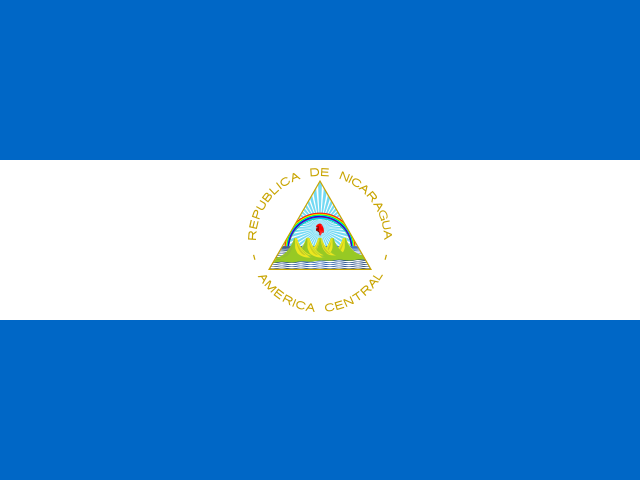 Miskitu (also known as Miskito)
Nicaragua · also HondurasThe Miskitu live along the Caribbean coast of northeastern Nicaragua and neighbouring Honduras, in savannah villages, along rivers such as the Río Coco and in towns such as Bilwi. They have their own language, Miskitu, and most make a living through farming and fishing. The Moravian church plays a central role in many Miskitu communities.
Traditionally, Miskitu communities held property in common and were guided by a council of elders.

Colourful Ngäbe dresses. Photo: Eliseo Carpintero (ECarpintero), CC BY-SA 4.0, via Wikimedia Commons 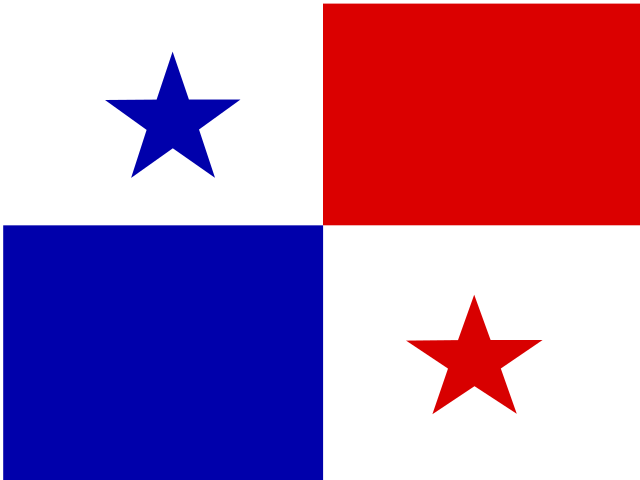 Ngäbe (also known as Guaymí)
Panama · also Costa RicaThe Ngäbe are Panama's largest Indigenous people, with about 445,000 people counted in the 2023 census, living mainly in the mountains and along the coasts of western Panama. They speak Ngäbere, a Chibchan language. Families farm corn, beans, sweet manioc and plantains, and fishing is important in coastal communities.
The Ngäbe make up nearly two-thirds of Panama's Indigenous population.

A mola, the layered cloth panel sewn by Guna women. Photo: Hiart, CC0, via Wikimedia Commons Guna (also known as Kuna)
Panama · also ColombiaMost Guna live in Guna Yala, a semi-autonomous comarca on Panama's Caribbean coast and its many islands, and their language is still widely spoken, including in Panama City. Each island community is led by a saila, a leader who recites Guna oral history and laws, and the Guna General Congress chooses national chiefs. Fishing, crafts and tourism support many families.
Guna women's molas, hand-sewn appliqué panels with bold geometric designs worn on blouses, are central to Guna identity.

A Bribri palenque, a cone-roofed house, in Talamanca. Photo: Everjean, CC BY 2.0, via Wikimedia Commons 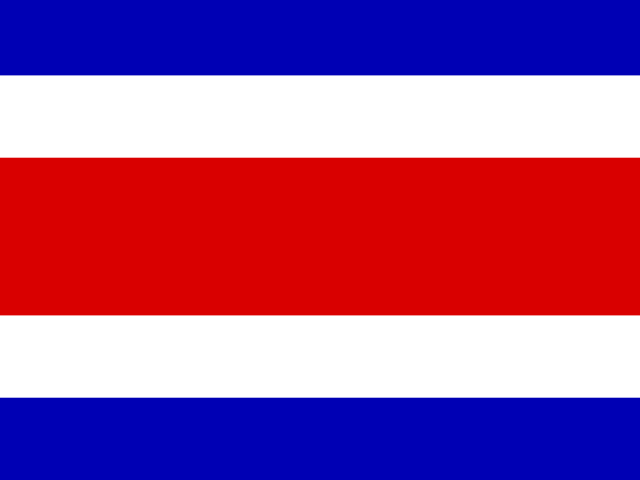 Bribri
Costa Rica · also PanamaThe Bribri live mainly in Indigenous territories in the Talamanca region of southern Costa Rica, near the Panama border, with a small community in Panama. Their language, Bribri, belongs to the Chibchan family and is one of the best-preserved Indigenous languages in Costa Rica.
Linguistic and genetic research suggests Chibchan-speaking peoples such as the Bribri have lived in what is now Costa Rica for at least 10,000 years.

The Kalinago Territory on the east coast of Dominica. Photo: Hans Hillewaert, CC BY-SA 3.0, via Wikimedia Commons 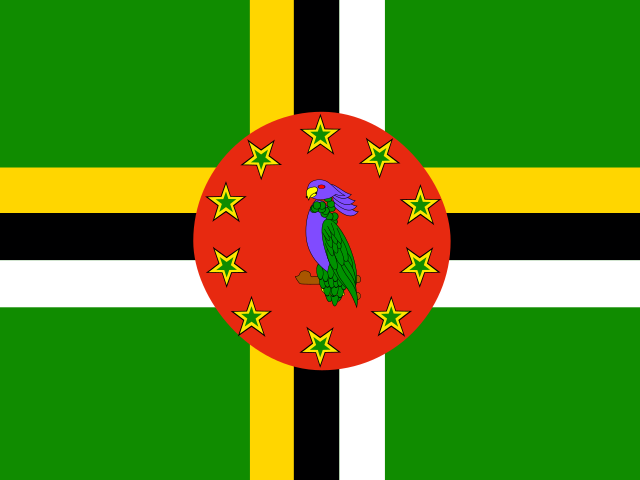 Kalinago
DominicaThe Kalinago live mainly in the Kalinago Territory on Dominica's east coast, set aside in 1903, and number about 4,000. Most work in farming, fishing and handicrafts. Their ancestors travelled in fleets of large canoes between the coast of South America and the islands of the Caribbean.
Residents of the Kalinago Territory elect their own Chief and a six-member council for five-year terms.

Quechua women weaving in Ollantaytambo. Photo: Thayne Tuason, CC BY 4.0, via Wikimedia Commons  Quechua
Peru · also Bolivia, Ecuador, Argentina, Colombia, ChileQuechua peoples live throughout the Andes, and in Peru alone about 5.2 million people identify as Quechua, many in the central and southern highlands. Quechua is a family of related language varieties, learned in childhood by about 3.8 million people in Peru. Growing potatoes, other tubers and quinoa on terraces, herding in the highlands and shared community work remain central to many communities.
Huayno music and more than a hundred traditional dances bring colour to Quechua patron-saint, harvest and canal-cleaning festivals.

An Aymara man with a totora reed boat on Lake Titicaca. Photo: EEJCC, CC BY-SA 4.0, via Wikimedia Commons  Aymara
Bolivia · also Peru, Chile, ArgentinaThe Aymara live mainly on the Altiplano, the high, windy plateau of the central Andes in Bolivia and Peru, including the shores of Lake Titicaca. Their language is also called Aymara. Growing crops such as quinoa, herding and fishing on Lake Titicaca have long sustained Aymara communities.
Aymara festivals, including those in La Paz, feature spectacular traditional dances such as the Morenada.

An Asháninka dance. Photo: Carly Rojas, CC BY-SA 2.0, via Wikimedia Commons Asháninka
Peru · also BrazilThe Asháninka are the most numerous Indigenous people of the Peruvian Amazon, living in the forested hills and river valleys of central Peru such as the Ene, Tambo and Perené. Their language, Asháninka, belongs to the Arawak family. Families grow cassava in some thirty varieties, along with coffee and cacao, and also hunt and fish.
The cushma, a cotton tunic woven by Asháninka women and coloured with plant and bark dyes, is worn by both men and women.

A ruka, the traditional Mapuche house. Photo: order_242 from Chile, CC BY-SA 2.0, via Wikimedia Commons  Mapuche
Chile · also ArgentinaThe Mapuche live in Wallmapu, a homeland that spans the Andes, with most in Chile's Central Valley south of the Biobío River and many in Argentina's Neuquén and Río Negro provinces. Their language, Mapudungun (also written Mapuzungun), is taught in community workshops and bilingual schools. Land is central to Mapuche life and identity, and women play a major role in Mapuche organizations.
Mapuche call the Chilean side of their homeland Ngulumapu, 'the western land', and the Argentine side Puelmapu, 'the eastern land'.

Wayuu mochilas, crocheted bags. Photo: Alejandra Quintero Sinisterra, CC BY 2.0, via Wikimedia Commons  Wayuu
Wayuu
Colombia · also VenezuelaThe Wayuu live on the dry Guajira Peninsula, which spans northern Colombia and Venezuela, and they are the largest Indigenous people in both countries. They speak Wayuunaiki, and society is organized in matrilineal clans in which the maternal uncle holds an honoured role.
Wayuu disputes are settled by the pütchipü'ü, or 'palabrero', a respected mediator, a system UNESCO recognized as intangible heritage in 2010.

Inside a shabono, the round communal house of a Yanomami village. Photo: Cmacauley, CC BY-SA 4.0, via Wikimedia Commons  Yanomami
Brazil · also VenezuelaThe Yanomami live in the rainforest and mountains of the northern Amazon, on both sides of the border between Brazil and Venezuela, with about 30,000 people in Brazil. They speak languages of the Yanomami family. Communities grow gardens in forest clearings and hunt, fish and gather in the surrounding forest, which they see as a living being.
Many Yanomami communities share one large communal house, called a yano or xapono, that is home to several families.

Shuar designs and patterns. Photo: Juan Carlos Fonseca Mata, CC BY-SA 4.0, via Wikimedia Commons  Shuar
Shuar
Ecuador · also PeruThe Shuar live in the Amazon rainforest and foothills of southeastern Ecuador, with smaller communities in Peru, in several hundred communities. Shuar community centres join together in federations, which have been organized since 1964. Farming maize, cassava and plantains is central to daily life, and respect for elders and hard work are core values.
Traditional Shuar music features the tampur drum, the pinkui flute and the shacap rattle.

Ñandutí, a fine spider-web lace made in Paraguay. Photo: Overkill53, CC BY-SA 4.0, via Wikimedia Commons  Guaraní
Paraguay · also Brazil, Argentina, BoliviaGuaraní peoples live in Paraguay, Brazil, Bolivia and Argentina, in similar numbers in each. In Paraguay the Mbya Guaraní, Ava Guaraní, Paĩ Tavyterã, Aché and others are among the country's 19 Indigenous peoples, and the 1992 Constitution describes Paraguay as pluricultural and bilingual. Land remains central to Guaraní community life.
Guaraní is one of Paraguay's two official languages alongside Spanish, and about two-thirds of Paraguayans speak it.

A Pemón guide at a hut in the Gran Sabana. Photo: Alejandro afc, CC BY-SA 3.0, via Wikimedia Commons  Pemón
Pemón
Venezuela · also Brazil, GuyanaThe Pemón live in southeastern Venezuela near the borders with Guyana and Brazil and are the country's fourth-largest Indigenous people, with about 30,000 people in 2011. They include three groups with their own dialects: the Kamarakoto, Taurepán and Arekuna. Farming cassava, sweet potatoes, yams and plantains is central, alongside small-scale hunting and fishing.
Pemón women make ceramics and plant-fibre baskets, and cotton is woven into hammocks.
Asia

An Ainu robe with appliqué patterns (Metropolitan Museum of Art). Photo: The Metropolitan Museum of Art, CC0, via Wikimedia Commons  Ainu
Ainu
JapanThe Ainu are the Indigenous people of northern Japan, especially Hokkaido, and historically also of Sakhalin and the Kuril Islands. They have their own language, Ainu, which is unrelated to Japanese. Ainu culture centres on respect for kamuy, the spirits of the natural world, and on arts such as mukkuri music and dance.
Upopoy, Japan's National Ainu Museum and Park in Hokkaido, takes its name from an Ainu word meaning "singing together in a large group".

Orang Asli dancers at a celebration. Photo: Jenny Gould, CC BY-SA 2.0, via Wikimedia Commons  Orang Asli
MalaysiaOrang Asli, meaning "original people" in Malay, are the Indigenous peoples of Peninsular Malaysia. About two-thirds live in the states of Pahang and Perak. Semang and Senoi peoples speak Mon-Khmer languages, while Proto-Malay peoples such as the Jakun speak Malay dialects.
The name Orang Asli covers 18 distinct peoples in three main groups: the Semang, the Senoi and the Proto-Malay.

A Dayak longhouse in Borneo. Photo: Tropenmuseum (unknown photographer), CC BY-SA 3.0, via Wikimedia Commons  Dayak
Dayak
Indonesia · also Malaysia, BruneiDayak is a shared name for many Indigenous peoples of Borneo's interior, such as the Ngaju, Kayan, Kenyah and Bidayuh, living mainly in Indonesian Kalimantan and in Malaysia's Sarawak. Dayak languages belong to the Austronesian family. Many Dayak villages grow hill rice and fish and hunt along Borneo's great rivers.
Many Dayak communities have traditionally lived together in longhouses, single buildings that can be home to a whole village.
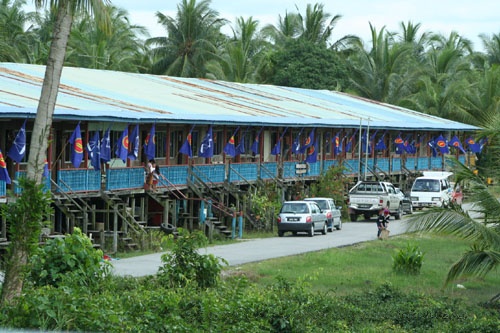
Iban longhouses near Bintulu, Sarawak. Photo: Calvinaj, CC BY 3.0, via Wikimedia Commons Iban
Malaysia · also Brunei, IndonesiaThe Iban are an Indigenous people of Borneo who live mainly in Sarawak, Malaysia, and in Brunei. They speak Iban, an Austronesian language related to Malay. In rural areas, many Iban families grow rice through shifting cultivation.
The Iban make up more than a quarter of Sarawak's population and celebrate Gawai Dayak with colourful parades in Kuching.

A traditional Kadazan house from Penampang. Photo: Enziee, CC BY 4.0, via Wikimedia Commons Kadazandusun (also known as Kadazan-Dusun)
MalaysiaThe Kadazandusun are the largest Indigenous group in Sabah, Malaysia, making up about 30 per cent of the state's population. They have traditionally grown paddy and upland rice and fished and hunted in the hills and valleys of Sabah. The Sumazau is their best-known traditional dance.
Their Harvest Festival, held every year on 30 and 31 May, gives thanks for the rice harvest and is Sabah's biggest Kadazandusun celebration.
Sources

The Batad rice terraces, built by the Ifugao people. Photo: Johnkevinreglos, CC BY-SA 4.0, via Wikimedia Commons  Igorot
PhilippinesIgorot is a shared name for about ten Indigenous peoples of the Cordillera mountains of northern Luzon, including the Ifugao, Kankanaey, Ibaloi, Bontoc and Kalinga. Their languages belong to the Austronesian family. Many highland Igorot communities grow wet rice on terraces built into the mountainsides, and they are known for weaving and metalwork.
The Ifugao rice terraces of the Cordillera have been farmed for about 2,000 years and are a UNESCO World Heritage Site.

A woman in traditional Karen dress. Photo: Soonduggyhuppy, CC BY-SA 4.0, via Wikimedia Commons  Karen
Karen
Myanmar · also ThailandThe Karen are an Indigenous people of southeastern Myanmar and neighbouring parts of Thailand. They speak several related Karen languages of the Sino-Tibetan family, including Sgaw and Pwo. Karen communities are known for their cultural and linguistic diversity, with lowland and upland groups.
The Karen are Myanmar's second-largest ethnic group, with many distinct communities in the hills and river valleys.

Santal dancers at a festival. Photo: ᱤᱧ ᱢᱟᱛᱟᱞ, CC BY-SA 4.0, via Wikimedia Commons  Santal (also known as Santhal)
India · also Bangladesh, NepalThe Santal are one of India's largest Adivasi peoples, living mainly in Jharkhand, West Bengal and Odisha, with smaller communities in Assam, Bangladesh and Nepal. They speak Santali, a Munda language with about six million speakers. In their own language they call themselves hɔṛ, and their language hɔṛ rɔṛ.
Santali is an official scheduled language of India and has its own Indigenous script as well as being written in other scripts.

A Gond painting. Photo: Roboture, CC BY-SA 3.0, via Wikimedia Commons Gond
IndiaThe Gond are a group of Adivasi peoples of central and south-central India, living in states such as Madhya Pradesh, Chhattisgarh, Maharashtra, Telangana and Odisha. Many speak dialects of Gondi, a Dravidian language. Farming is central to Gond life, and their religion honours clan and village deities and ancestors.
Gondi is a Dravidian language, related to Tamil and Telugu, spoken in many dialects across central India.

Bhil dancers at a festival in Gujarat. Photo: Tawaranil, CC BY-SA 4.0, via Wikimedia Commons Bhil
IndiaThe Bhil are one of India's largest Adivasi peoples, with about 12.6 million people living in the uplands of Rajasthan, Gujarat, Madhya Pradesh and Maharashtra. Nearly all Bhil communities farm, most of them with the plough.
Unlike most Adivasi peoples, who speak Munda or Dravidian languages, the Bhil speak Indo-Aryan dialects related to Gujarati.

Naga dancers at the Hornbill Festival in Nagaland. Photo: Rod Waddington, CC BY-SA 2.0, via Wikimedia Commons Naga
India · also MyanmarThe Naga are more than 20 peoples, including the Konyak, Ao, Tangkhul, Sumi and Angami, living in the Naga Hills on the India–Myanmar border. They speak many Tibeto-Burman languages, and almost every village has its own dialect. Many Naga villages grow rice and millet on hillside fields, and weaving and wood carving are important crafts.
Because Naga languages are so varied, people from different Naga communities often talk to each other in Nagamese or English.

A double-decker living root bridge grown by Khasi villagers. Photo: Chiranjeeb Baul, CC BY-SA 4.0, via Wikimedia Commons Khasi
India · also BangladeshThe Khasi are an Indigenous people of the Khasi and Jaintia Hills in Meghalaya, northeastern India. They speak Khasi, an Austroasiatic language. Most Khasi families farm, growing wet rice in valleys and on hillside terraces.
Khasi society is matrilineal: property and family succession traditionally pass from mother to youngest daughter.

A Chakma woman weaving on the balcony of a bamboo house. Photo: Angus Hume, Public domain, via Wikimedia Commons  Chakma
Bangladesh · also India, MyanmarThe Chakma are the largest Indigenous people of Bangladesh, living mostly in the Chittagong Hill Tracts, with communities in northeastern India and Myanmar. They speak Chakma, an Indo-Aryan language with its own script, and most follow Theravada Buddhism. Farming of rice, cotton and vegetables is central to Chakma life.
Chakma women weave distinctive textiles, a craft that provides both family clothing and income.

People walking to a Tharu food festival in Sauraha. Photo: TheNissassa, CC BY-SA 4.0, via Wikimedia Commons  Tharu
Tharu
Nepal · also IndiaThe Tharu are an Indigenous people of the Terai, the lowlands at the foot of the Himalayas in southern Nepal and in Uttar Pradesh, India. They speak several dialects of Tharu, an Indo-Aryan language. Most Tharu families farm, raise cattle, fish and gather forest products.
More than 1.5 million Tharu live in Nepal, where each village traditionally has its own council and headman.

Tengboche Monastery in the Khumbu, a Sherpa Buddhist monastery. Photo: Vyacheslav Argenberg, CC BY 4.0, via Wikimedia Commons Sherpa (also known as Sharwa)
Nepal · also India, ChinaThe Sherpa are an Indigenous people of the high Himalaya, living mainly in Nepal, with communities in India and Tibet. They speak Sherpa, a language closely related to Tibetan, and share Tibetan cultural roots. Their homeland includes high valleys close to Mount Everest.
Many Sherpa are renowned high-altitude mountain guides, and their expertise has been central to climbing on Mount Everest.
Europe

Greenlandic dancers in national costume in Ilulissat. Photo: Vadeve, Public domain, via Wikimedia Commons  Kalaallit (also known as Greenlandic Inuit)
DenmarkKalaallit are the Inuit of West Greenland, the largest group among Greenland's Inuit, alongside the Inughuit of the far north and the Iit of the east; nearly nine in ten Greenlanders are mainly of Inuit descent. Kalaallisut (West Greenlandic) has been Greenland's sole official language since the 2009 Self-Government Act. Fishing is the base of the economy, and sea mammals remain an important source of food.
Soapstone carving, drum dancing and kayak building remain living traditions in Greenland today.
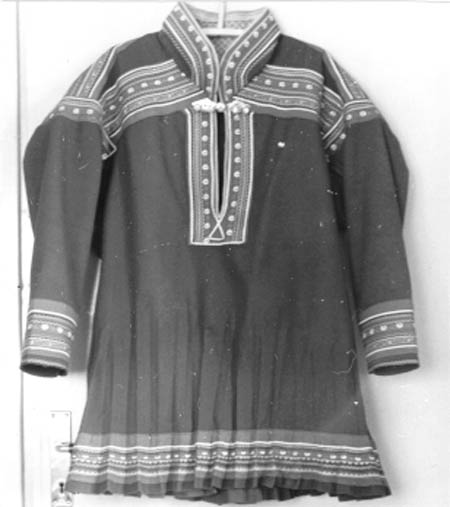
A gákti, the traditional Sámi garment. Photo: Soile Sarvisto, CC BY-SA 4.0, via Wikimedia Commons  Sámi
Sámi
Norway · also Sweden, Finland, RussiaThe Sámi are the Indigenous people of Sápmi, which stretches across the north of Norway, Sweden, Finland and Russia, and most Sámi live in Norway. Nine Sámi languages are spoken today. Reindeer herding, fishing, farming and hunting have long been at the heart of Sámi life, and since 1989 the Sámi in Norway have elected their own parliament, the Sámediggi.
Sámi National Day on 6 February is celebrated in all four countries of Sápmi and has been an official flag day since 2003.
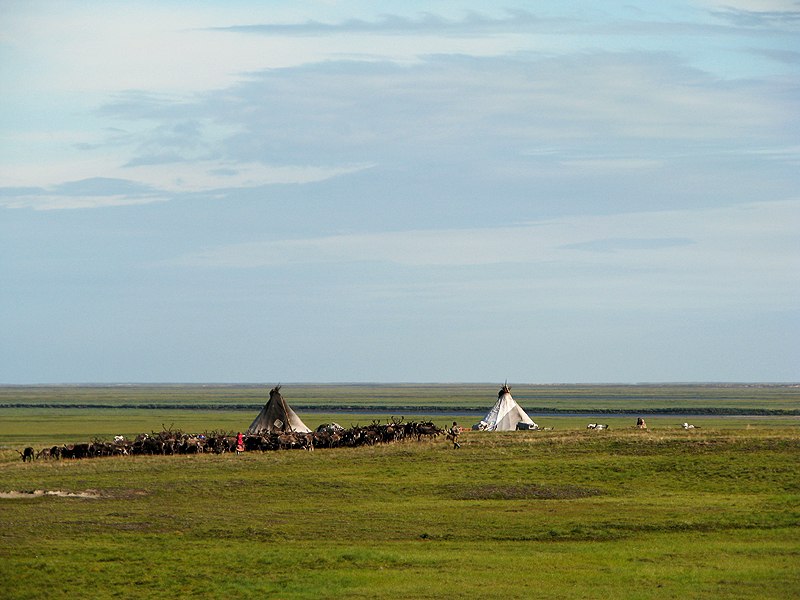
A Nenets camp with reindeer in the tundra of Yamal. Photo: Sergey.vlad.popov, CC BY-SA 4.0, via Wikimedia Commons  Nenets
RussiaThe Nenets live across Russia's far north, from the White Sea to the Taymyr Peninsula, as Tundra Nenets and Forest Nenets. They speak Nenets, the largest of the Samoyedic languages in the Uralic family. Reindeer herding, fishing and hunting remain central to Nenets life on the tundra.
A Nenets family's reindeer provide food, hides for clothing and winter tents, sinew for thread and antler for tools.

Traditional Sakha (Yakut) costumes made of deer leather. Photo: Gretatsittser, CC BY-SA 4.0, via Wikimedia Commons Sakha (also known as Yakut)
RussiaThe Sakha are the Indigenous people of the Sakha Republic (Yakutia) in northeastern Siberia, Russia. They speak Sakha, a Turkic language. Despite the Arctic climate, the Sakha have long raised horses and cattle, and dairy foods are central to their cuisine.
The khomus, a Sakha mouth harp, is enjoying a strong revival, and Sakha artists are known for ivory and wood carving and jewellery.

A yaranga, the Chukchi skin tent, at Uelen in 1913. Photo: A. M. Collins, Public domain, via Wikimedia Commons Chukchi
RussiaThe Chukchi live in Chukotka, at the far northeastern tip of Russia. Reindeer Chukchi have traditionally herded reindeer in the interior, while Maritime Chukchi live along the Arctic and Bering Sea coasts, fishing and hunting sea mammals. Their language is related to Koryak and Itelmen.
Maritime Chukchi communities have traditionally been organised around boat teams of related families who hunt and fish together at sea.

An Evenki family riding reindeer in 1907. Photo: A. A. Makarenko, Public domain, via Wikimedia Commons Evenki (also known as Evenk)
Russia · also China, MongoliaThe Evenki are the most widespread of the Indigenous peoples of northern Siberia, with communities across Russia and in northeastern China and Mongolia. Many Evenki in the taiga are reindeer herders and hunters, while others raise horses and cattle or farm. Many Evenki today are bilingual.
The Evenki homeland in the taiga stretches from the Ob–Irtysh watershed east to the Sea of Okhotsk and north to the Arctic Ocean.

A Khanty sewing bag made of reindeer leather. Photo: Daderot, CC0, via Wikimedia Commons Khanty
RussiaThe Khanty live along the Ob River and its tributaries in western Siberia, Russia. They speak Khanty, an Ob-Ugric language of the Uralic family. Fishing, hunting and trapping have long sustained Khanty families, and many Khanty also herd reindeer.
The Khanty and their Mansi neighbours are the only northern Siberian peoples with traditional stringed instruments, including a five-stringed zither.
Oceania

Carved posts and tukutuku panels in a Māori meeting house. Photo: portengaround, CC BY-SA 2.0, via Wikimedia Commons  Māori
Māori
New Zealand · also AustraliaMāori are the tangata whenua, the people of the land, of Aotearoa New Zealand, where they have lived for over 700 years. Te reo Māori, their language, is an official language of New Zealand. Being Māori means honouring one's ancestors and keeping connections to ancestral land.
Te reo Māori became an official language of New Zealand in 1987, and kōhanga reo preschools help children grow up speaking it.

Wooden figures carved at Yirrkala. Photo: unknown, CC BY-SA 3.0 pl, via Wikimedia Commons  Yolŋu (also known as Yolngu)
AustraliaThe Yolŋu are the Aboriginal people of north-east Arnhem Land in Australia's Northern Territory, living at Yirrkala and in more than 25 homeland communities. Yolŋu means "people", and Yolŋu clans are closely related in culture and language. Art is a powerful way for Yolŋu to express identity and their title to land.
Every Yolŋu clan belongs to one of two moieties, Dhuwa or Yirritja, which link people, land and family.

A Noongar woman with a coolamon, a carrying dish. Photo: IngridC-Curtin, CC BY-SA 4.0, via Wikimedia Commons Noongar
AustraliaThe Noongar are the Aboriginal people of the south-west of Western Australia, where they have lived for at least 45,000 years. Noongar boodja (Country) stretches from north of Jurien Bay to the south coast near Esperance. The Noongar nation is one of the largest Aboriginal cultural blocs in Australia, with up to 15 dialects of the Noongar language.
In 2016 the Western Australian Parliament recognised the Noongar people as Traditional Owners of the south-west through an Act of Parliament.

A Torres Strait dance mask. Photo: Szilas, Public domain, via Wikimedia Commons Torres Strait Islanders
AustraliaTorres Strait Islanders are one of Australia's two Indigenous peoples, distinct from Aboriginal peoples, with homelands in the islands of the Torres Strait. Their communities are grouped into five island groups, and many Torres Strait Islanders also live on mainland Australia. The land and the sea are central to Torres Strait Islander life and identity.
The Torres Strait Islander flag shows a white dhari (dancer's headdress) and a five-pointed star for the five island groups.

An Aṉangu guide at Uluṟu. Photo: Prince Roy, CC BY 2.0, via Wikimedia Commons Aṉangu (also known as Anangu)
AustraliaAṉangu are the Pitjantjatjara and Yankunytjatjara peoples of central Australia, the traditional owners of Uluṟu-Kata Tjuṯa National Park. They speak their own languages and teach them to their children. Their lives centre on Tjukurpa, their traditional law, which lives in the land and the people.
Aṉangu welcome visitors to Uluṟu with the words: "This is Aṉangu land and you are welcome."

A Fijian meke, a traditional dance. Photo: Unknown photographer, Public domain, via Wikimedia Commons  iTaukei (also known as Indigenous Fijians)
FijiThe iTaukei are the Indigenous people of Fiji. iTaukei society is organised through chiefly leadership and communal land, and Fiji's 14 Provincial Councils represent iTaukei communities. The iTaukei Affairs Board works to preserve the iTaukei language, culture and traditions.
The iTaukei Affairs Board, first set up in 1944, coordinates Fiji's 14 Provincial Councils and helps protect iTaukei language and culture.
Sources